

Robotic Soldering System
A robotic soldering system is an automated manufacturing solution designed to join electronic components and metal parts with precision, consistency, and speed. It is widely used in industries such as electronics assembly, automotive manufacturing, aerospace, telecommunications, medical devices, and consumer products. By replacing or assisting manual soldering, the system improves production efficiency, reduces human error, and delivers stable quality across large-scale and repetitive tasks.At the core of a robotic soldering system are several integrated components: a robotic arm, a soldering iron or soldering head, a control unit, a vision or sensing system, and a solder wire feeding mechanism. The robotic arm provides flexible movement in multiple directions, allowing the soldering tool to reach complex positions with high accuracy. The control unit manages motion paths, temperature settings, soldering speed, and process timing. A vision system or sensor array is often used to identify workpiece location, confirm alignment, and monitor the soldering process in real time.One of the main advantages of robotic soldering is precision. Manual soldering can vary depending on the operator’s skill, fatigue, or attention level, while a robotic system follows programmed instructions with repeatable accuracy. This ensures uniform solder joints, better electrical conductivity, and reduced defects such as cold joints, overheating, or excessive solder. For delicate components and compact circuit boards, this precision is especially valuable.Another major benefit is productivity. Robotic soldering systems can work continuously with minimal interruption, making them suitable for high-volume production environments. They can complete repetitive operations much faster than human workers while maintaining consistent quality. In addition, automation helps lower labor costs over time and reduces the risk of injuries caused by prolonged exposure to heat, fumes, or repetitive motion.Modern robotic soldering systems also support different soldering methods, including point soldering, drag soldering, and selective soldering. Some advanced systems can be programmed for multiple product models, making them adaptable to changing production demands. With software control, operators can store and recall soldering paths, temperatures, and process parameters for different assemblies, which improves flexibility and shortens setup time.Quality control is another important feature. Many systems include sensors that monitor temperature, solder amount, tip condition, and joint formation. If abnormal conditions are detected, the system can pause, alert the operator, or adjust the process automatically. This reduces waste and helps maintain strict manufacturing standards.Overall, a robotic soldering system represents a smart combination of automation, accuracy, and reliability. It enhances manufacturing efficiency, improves product quality, and supports modern production lines that require both speed and consistency. As industries continue to demand more complex and miniaturized electronic assemblies, robotic soldering will remain an important tool for achieving high-performance results.
Products
Category:
-
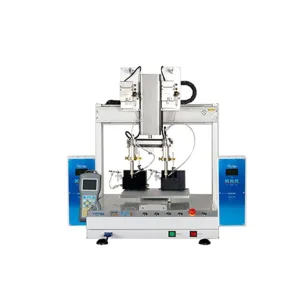
CHUERA-3-Axis Dual-Head Automatic Soldering Machine
Category: Automation RobotsBrowse number: 56Number:Release time: 2026-06-27 14:34:12The 3-Axis Dual-Head Automatic Soldering Machine is a high-efficiency industrial robotic soldering system designed for modern electronics manufacturing. It integrates a 3-axis motion structure with a dual soldering head design, enabling simultaneous or alternating soldering operations to significantly improve production efficiency and consistency.
News
Category:
No search results found!
Case
Category:
No search results found!
Video
Category:
No search results found!
Download
Category:
No search results found!
Job
Category:
No search results found!
Featured Products
-
NEWS
CHUERA-3-Axis Dual-Head Automatic Soldering Machine
Learn more



 Phone
Phone